Futuristic System Brings Vision to Blind
ST. LOUIS -- A Saint Louis University neurosurgeon has become the
first U.S. doctor to implant a potentially revolutionary electronic eye
device that allows a blind patient to see. He is the only United States
doctor ever to perform the procedure.
Kenneth R. Smith Jr., M.D., professor of neurosurgery at Saint Louis
University School of Medicine, performed the two- to three-hour surgical
procedure in Lisbon, Portugal, in April. He was one of four specialists
who operated on eight blind patients who paid to receive artificial
vision systems developed by the Dobelle Institute.
A report on the progress of the patients -- and news that the
artificial vision system now is commercially available abroad -- was
presented June 13 at the 48th annual meeting of the American Society for
Artificial Internal Organs in New York.
"With this technology, there's new hope that some patients who have
lost their vision through trauma can unscramble light patterns well
enough to function," Smith said. "Patients who live in darkness
potentially have a light at the end of the tunnel."
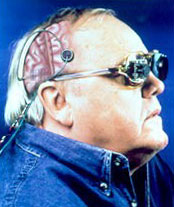
The artificial vision system is a more complicated version of the
visor worn by Geordi La Forge, the blind chief engineer in the science
fiction television show Star Trek: The Next Generation. Patients
are implanted with devices that act as artificial eyes by stimulating
the visual cortex of the brain.
Two patients, who had been totally blind before their surgeries in
April, have already learned to use the prosthetic system well enough to
slowly drive cars on private property. They could walk freely around a
laboratory, avoid obstacles and look outside a window to see a tree.
"It's amazing now. It was science fiction a few years ago," said
William H. Dobelle, Ph.D., chairman and chief executive officer of The
Dobelle Institute, developer of the artificial vision system. Dobelle
had consulted with the writers of Star Trek: Next Generation,
before they created a blind character who used an artificial vision
system to see.
"As our technology improves and becomes less costly, Braille will
become obsolete, the long cane will become obsolete and the guide dog
will become obsolete as surely as the airplane replaced the steamship,"
Dobelle said.
Smith has been working with the Dobelle Institute, a privately held
company that creates medical devices, since 1970. Dobelle began
developing an artificial vision system in 1968, and the project has
picked up steam as computer technology has improved.
The artificial vision system is designed for patients who have lost
their vision from an injury and are not candidates for retinal implants.
The procedure costs $98,000.
Patients use special sunglasses fitted with a miniature television
camera and a microcomputer and stimulator. The gear attaches by cable to
a tiny fire hydrant-like device implanted in the back of the skull that
connects to electrodes on the surface of the visual part of the brain.
Patients don't have "normal" vision." Instead, they see white flashes
of light that resemble stars on a black background, and learn to
interpret the patterns so they can gain mobility.
"By putting an array of electrodes in the brain, patients see a
pattern of white spots that they could learn to interpret well enough to
get some useful vision," Smith said.
Established in 1836, Saint Louis University School of Medicine has
the distinction of awarding the first M.D. degree west of the
Mississippi River. Saint Louis University School of Medicine is a
pioneer in geriatric medicine, organ transplantation, chronic disease
prevention, cardiovascular disease, neurosciences and vaccine research,
among others. The School of Medicine trains physicians and biomedical
scientists, conducts medical research, and provides health services on a
local, national and international level.