
http://www.marvast.com/great/musad.htm
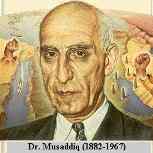 Dr. Musaddiq (1882-1967)
Dr. Musaddiq a charismatic leader, who mobilized an anti-colonialism movement in the early 1950's by challenging Iran's authoritarian political system and denouncing the economic exploitation of the British. Dr. Musaddiq was like Thomas Jefferson, a subtle and humane statesman and, above all, a leader who believed in "the sufficiency of reason for the care of human affairs." He was a complex and compelling man, a fervent advocate of democracy, a revolutionary who became Prime Minister, is one of the most ethical, and great leaders throughout human history because of the following reasons:
· Spokesman for human liberty.
· High moral and ethical values.
· Father of liberal democratic values for Iranian people as Thomas Jefferson was for the American people.
· Man of undisputed honesty and integrity.
· He refused to collect a salary, donating it to charity.
· Denouncing the economic exploitation of the British.
· Architects of Iran's oil nationalization. Oil issue was as significant for Iran as was independence for U.S.
· Political and religious toleration.
· Upheld the principle that developing countries should manage their own affairs as independently as possible.
· Established the High Council of Education, to improve and expand all aspects of education throughout the country.
· Building and strengthening of democratic institutions were given high priority by Musaddiq.
· Had taken important step towards freedom of press.
Time magazine selected Dr. Musaddiq as man of the year in 1952. Dr. Musaddiq was a devoted proponent of Enlightenment values and was dedicated to the task of bringing real independence and national dignity to his country.
Dr. Musaddiq was born into a wealthy Iranian family in May 1882. His father was a high-ranking financial administrator and man of distinction in the Qajar court. He was in his teens when his father died. Before the turn of the century Musaddiq had acquired extensive political and administrative experience by assuming, as was customary, one of his father's posts and becoming financial administrator of Khurasan province. He pursued his higher education in France and Switzerland, obtaining a doctorate in law from the University of Neuchatel in 1914. At the close of the First World War he campaigned effectively against British political and economic influence in Iran. In the early 1920s he served in high administrative posts in the provinces and in Tehran, and in 1924 he was elected to the parliament. His early administrative and parliamentary career was characterized by opposing British influence in Iran and by espousing constitutional principles. He resisted the creation of Pahlavi dynasty, and in 1925 he voted against Reza Khan's accession as the first Pahlavi Shah. Because of this from 1936 onwards he was forced to lead the life of an exile on his family estate. In June 1940 Musaddiq was exiled to Birjand. According to his own account, in the course of his journey to Birjand he twice attempted to commit suicide but failed. He was eventually returned to his estate six months later. This episode aggravated Musaddiq's hatred of royal authoritarianism and deepened his belief in democracy. The experience of exile, whether in Ahamadabad or Birjand, was accompanied by physical disability resulting in his often being unable to walk unaided.
The years of exile, on the other hand, had not only failed to obliterate the memory of Musaddiq in the public mind but had rather enhanced his prestige - a fact well demonstrated by his election as Tehran's first deputy to the Parliament (1944).
In 1951 Musaddiq accepted the position of premiership conditional upon parliament approving the principle of nationalization, and in the first year of his premiership, his main aim was to implement this. In the words of Husayn Fatimi, Musaddiq's loyal supporter and colleague, the oil issue was as significant for Iran as was independence for U.S., India, and Indonesia.
Endowed with personal charm and appeal, Musaddiq was capable of generating respect and conviction. He consistently adhered to principles and was a man of undisputed honesty and integrity. He made no use of his office for nepotistic ends or to maximize material gain; as a deputy in Parliament and as Prime Minister, he refused to collect a salary, donating it to charity. He personally met many of the expenses he incurred in an official capacity, transferred to the state whatever gifts he received, greatly reduced the ceremonial expenses of the prime minister's office, and cut its secret budget.
Musaddiq was deeply interested in an honorable settlement of the oil issue. He was skeptical of British readiness to come to an agreement with him, but he welcomed American mediation efforts, and was prepared to accept reasonable solutions. One such scheme was worked out in October-November 1951 with George McGhee, the US Assistant Secretary of State, but was eventually rejected by Anthony Eden, the British Foreign Secretary. But due to the colonialism nature of British government, they could not comprehend and recognize the Iranian rights to own and manage their own oil industry.
The U.S. found itself caught between Iran on the one hand which Americans believed to have legitimate national concerns and on the other hand Britain. The elected liberal democratic government of Dr. Musaddiq was overthrown by the joint British/U.S. sponsored coup of 1953. Following the coup of 1953, Dr. Musaddiq was condemned to three years imprisonment and subsequently confined to his home by the military tribunal, to lead a lonely life until his death in March 1967 at the age of 84.
The American scholar Professor James A. Bill in the book 'Musaddiq, Iranian Nationalism, and Oil' made following major points:
· The Democratic Administration of President Harry Truman and Secretary of State Dean Acheson were reluctant to adopt the threatening tactics contemplated by key British officials to counter nationalization in Iran.
· The Eisenhower Administration, with the encouragement and support of Secretary of State John Foster Dulles, CIA director Allen Dulles, and Under Secretary of State Walter Bedell Smith, decided to intervene directly to overthrow the government of Dr Musaddiq.
· The idea of the intervention originated with the British (SIS/M16) who used the threat of a possible communist takeover as their major tactic in attracting American involvement. The British and Americans co-operated fully in the venture.
· The operation in Iran was considered for years in Washington to be one of the major success stories of direct covert intervention. As such it acted as a catalyst for other CIA interventions, beginning with that in Guatemala in 1954.
· The events of 1953 in Iran damaged the image of the United States among the burgeoning forces of nationalism that came to prominence in the Middle East during 1960s and 1970s. In the words of William O. Douglas: when Mossadegh in Persia started basic reforms, we became alarmed. That man, whom I am proud to call my friend, was a democrat in the LaFollette-Norris sense of the term. We united with the British to destroy him; we succeeded; and ever since our name has not been an honored one in the Middle East.'
JFK As a Senator in July 2,1957 made the following statement:
"..the most powerful single force in the world today is neither communism nor capitalism, neither H-bomb nor the guided missile- it is man's eternal desire to be free and independent." This statement by JFK can be considered as the best description of Dr. Musaddiq movement during 50's. Dr. Musadiqq episode influenced series of events, which was carried on by the Suez episode, the Algerian struggle for independence, and Vietnam War.
Among the Iranian the memory of Dr. Musaddiq remains as a symbol of independence, Liberal Democratic values, and high moral and ethical values. Persians love and respect Dr. Musaddiq as Americans love and respect Thomas Jefferson.
Masoud Marvasti 1993